
Bondage is one dimension of bdsm practices that, when approached with care and honesty, can genuinely deepen intimacy and trust in your sex life. It asks something real of the people involved: vulnerability, presence, and a willingness to communicate about desires that many of us were never taught to voice. BDSM can enhance relationships by exploring new facets of sexuality, and bondage specifically heightens vulnerability and trust between partners in ways that few other experiences can replicate. But engaging in bondage requires a commitment to safety and communication from everyone at the table.
If your primary reference point for bondage is the fifty shades film series from 2015 to 2018, it’s worth knowing that those movies prioritized spectacle over substance. Real, ethical bondage doesn’t skip the negotiation, ignore aftercare, or treat consent as a mood-killer. It treats those things as the foundation that makes everything else possible.
This guide is for consenting adults only, focused on pleasure, connection, and risk awareness rather than shock value. Safe and fun bondage practices are those built on consent, communication, risk-aware choices, and mutual enjoyment. By the end, you’ll have a working understanding of equipment basics (including bondage tape), safety measures, communication habits, and aftercare.
Consent, Communication, and Ethics Before Any Rope Comes Out
Here’s the thing about ethical bondage: it starts long before any rope comes out. The negotiation isn’t a formality you rush through. It’s the actual foundation that makes play feel safe enough to be genuinely hot.
Practicing bondage safely is based on SSC or RACK principles. “Safe, Sane, and Consensual” (SSC) emerged in the early 1980s as a framework emphasizing that all parties involved should be in a rational state and freely choosing to participate. RACK, or “Risk-Aware Consensual Kink,” came along in 1999 to acknowledge that no intense play is entirely risk-free and that the real goal is being aware of those risks and making informed choices together. Both frameworks guide modern bdsm practices, and either one gives you a solid ethical starting point.
What this looks like in practice:
- Consent is non-negotiable. Consent must be explicit and enthusiastic for all activities. Not assumed, not implied, not guilted into. Enthusiastic consent means every person genuinely wants what’s about to happen, not just tolerates it.
- Negotiate everything in advance. Both partners must communicate their limits and desires before a scene begins. Discuss fantasies, hard limits (no breath play, no suspension, no genital bondage), and soft limits (things you’re curious but uncertain about). Communicate boundaries and negotiate types of play before anyone is tied up.
- Establish a safe word. A safeword is essential for ensuring consent in BDSM. The green/yellow/red system works well: green means continue, yellow means slow down and check in, red means stop immediately. If speech is impeded (gagging, for example), agree on nonverbal signals like hand squeezes or dropping an object. Clear communication systems are vital in bondage activities.
- Fantasy versus reality. Roleplaying force or resistance only works because both partners have agreed in advance. The dom and the person being restrained both understand the scene is consensual and temporary.
- Either partner can stop at any time. Say this out loud before you begin. No guilt, no shame, no reproach. Consent should be informed and ongoing during sessions.
- Emotional safety is critical in BDSM practices. This means your partner understands that their emotional experience matters as much as the physical one. Communication is essential before and during bondage sessions, not just when something goes wrong.
Bondage Safety 101: Bodies, Risks, and Red Flags
This is the section you don’t skip. Everything else in this guide rests on understanding what can go wrong physically and knowing how to prevent it.

The biggest risk in bondage is nerve compression or injury. A 2023 study of rope bondage participants found that radial nerve injuries (in the mid-upper arm) accounted for roughly 90% of the nerve injuries observed across 10 individuals. Motor weakness, numbness, and loss of function followed. Recovery was generally favorable when damage was caught early, but the point is clear: anatomy matters.
Here’s your practical safety checklist:
- Avoid tying too tightly to prevent numbness or nerve damage. Stay away from tying directly over wrists, inner elbows, the neck, or any joint. These are high-risk nerve areas.
- Periodic checks for circulation and breathing are essential during bondage. Every 5 to 10 minutes, check for numbness, tingling, skin turning pale or blue, coldness, or inability to move fingers and toes. Be cautious of positions that restrict breathing.
- Never leave a restrained partner unattended during bondage. Not even to grab a glass of water. Delays in responding to a sign of trouble can turn a minor issue into a serious one.
- Avoid engaging in bondage while under the influence of impairing substances. Intoxication reduces your ability to give consent, detect warning signs, and respond to emergencies.
- Always keep safety shears within arm’s reach during bondage. Safety scissors or EMT trauma shears can cut through rope or tape in seconds. Use tools nearby to safely remove restraints in an emergency. Practice using them beforehand so you’re not fumbling when it matters.
- Respect your partner’s physical health and limitations during bondage. A body that was comfortable last week might not be today.
- Suspension and complex harnesses are not beginner territory. These require in-person training with experienced riggers. Attempting them from online videos alone carries serious risk of nerve damage, falls, or circulation failure.
- Start slow. Beginners should start with low-risk positions: wrists bound in front, simple under-the-mattress restraints, or soft cuffs. You don’t need fancy equipment to have a meaningful experience.
Choosing Safe Bondage Gear: From Bondage Tape to Soft Rope
The right equipment makes bondage both safer and more pleasurable. You don’t need to invest a fortune, but you do need to choose thoughtfully.
- Bondage tape sticks to itself, making it safe for beginners. It won’t pull hair or tear skin, it’s adjustable and forgiving, and it’s widely available online. For first-time experiments, it’s hard to beat.
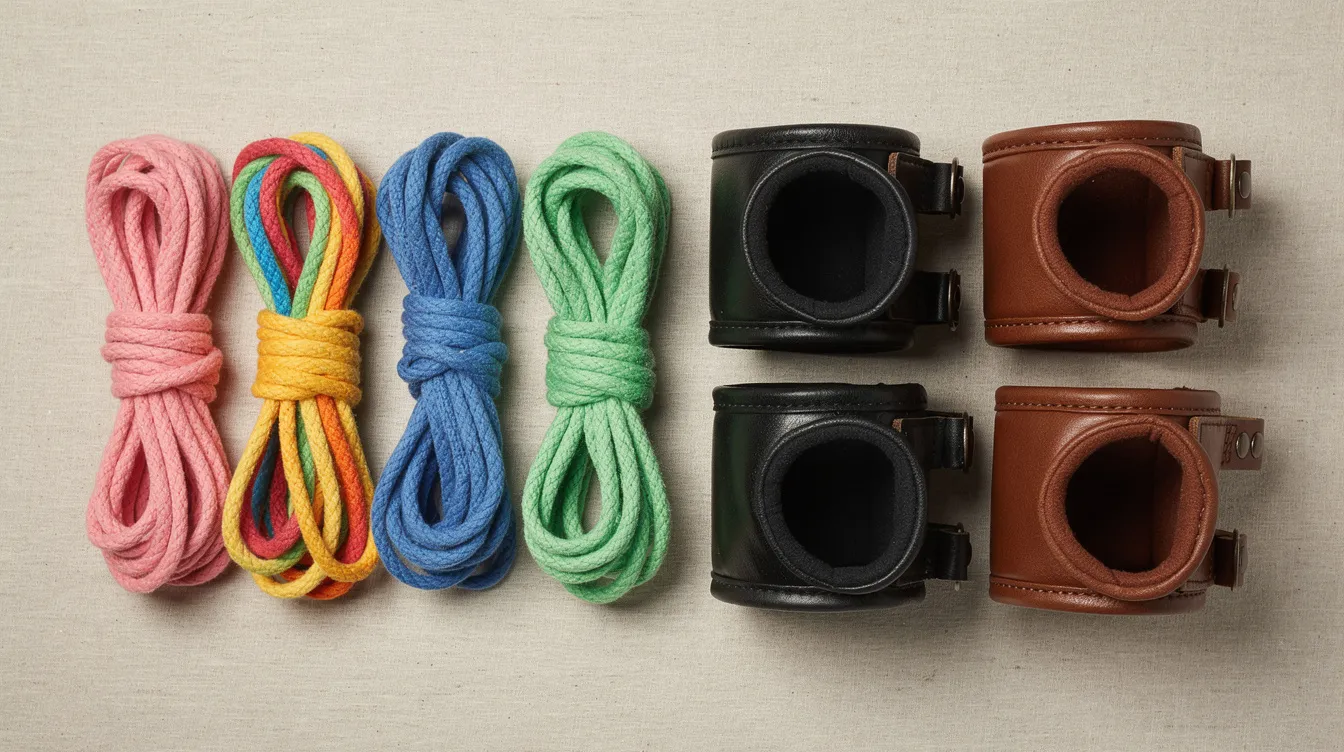
- Soft restraints are your friend. Light bondage uses soft restraints like plush handcuffs, padded cuffs with Velcro, under-bed restraint kits, or soft leather cuffs with wide, smooth interiors.
- Beginner-friendly rope should be soft cotton or hemp, approximately 6 to 8 mm in diameter, with a smooth texture. Avoid anything too stiff, rough, or thin.
- Household alternatives can work with care: wide scarves, old cotton T-shirts cut into strips, or wide neckties. They should be at least 3 to 4 inches wide to distribute pressure. Nothing thin or elastic.
- What to avoid: duct tape, electrical tape, thin cord, paracord on bare skin, metal wire, or anything that tightens under strain. These materials are a mistake waiting to happen.
- Quick-release matters. Velcro straps, buckles, or pre-cut bondage tape ends let you free your partner in seconds when needed.
- Use high-quality bondage equipment to prevent injuries. Inspect bondage equipment for wear and tear before use. Check rope for fraying, cuffs for worn stitching, and metal hardware for rust or sharp edges. Any roughness can abrade or cut under load.
Fun, Beginner-Friendly Bondage Ideas to Spice Up Your Sex Life
Safe bondage can start gently and playfully. You don’t need complex knots or an entire dungeon setup to explore something that feels creative and intimate.
- Simple wrist ties. Try soft rope or bondage tape to loosely bind wrists together in front of the body. Pair this with kissing, oral sex, or slow teasing to keep the focus on connection rather than the tie itself.
- Bed bondage. An under-mattress restraint kit or ties to sturdy bedposts can feel intense without being complicated. Keep ties loose and adjustable, and check circulation regularly.
- Sensory play. Blindfolds enhance sensory experiences during light bondage. Removing sight focuses attention on touch and sound, making every sensation more vivid. Earplugs or headphones with erotic audio can amplify this further.
- Gentle impact combinations. Over-the-knee spanking with hands either free or lightly bound behind the back. Start slow and check in after each impact. Domination doesn’t have to be aggressive to be powerful.
- Psychological bondage. Verbal commands (“You can’t move,” “Stay exactly where I put you”) with minimal or no physical restraints. Psychological bondage can be as stimulating as physical restraints. The thrill of surrendering control can be psychologically appealing, and many people find that the struggle between desire and obedience is where the real heat lives.
These ideas are starting points, not a checklist. Let your own fantasy and your partner’s desires guide where things go next.
Communication During and After the Scene: Check-Ins and Aftercare
This is the emotional heart of safe bdsm. The best scenes in the world mean nothing if the people involved feel abandoned or confused afterward.
- Check-ins during play. Regularly check in with your partner’s comfort during bondage. Simple questions work: “Color?” or “How’s that feel?” Watch for nonverbal cues too: trembling, sudden silence, facial tension, hyperventilation. These can be a sign that something needs attention even if no one says “red.”
- Aftercare is crucial after a bondage session. It’s the period right after play where partners reconnect. Aftercare helps partners relax and reconnect post-scene through cuddling, water, warm blankets, snacks, or quiet conversation.
- Many bottoms experience sore muscles after bondage sessions. Gentle massage, stretching, and rest can help. Emotional support is a key component of aftercare, as much as physical comfort.
- Debriefing aftercare involves discussing what worked and what didn’t. Schedule a debrief within an hour or the next day. What felt amazing? What felt off? What would you adjust? This builds trust and makes every future scene better.
- Delayed emotional responses are normal. Some people feel teary, spacey, vulnerable, or even ashamed hours after a scene. This doesn’t mean something went wrong. It means the experience was intense and the body is still processing. Compassion and reassurance matter here.
- Aftercare needs vary. Some people want closeness and talking; others prefer quiet and alone time. This is worth negotiating in advance so neither person feels rejected or overwhelmed.

Special Situations: Solo Bondage, Power Dynamics, and When to Pause
Some scenarios carry extra risk and deserve very conservative decision-making. Being interested in pushing boundaries is natural. Being reckless about it is not.
- Solo bondage is high-risk. Tying yourself up without anyone present means that if something goes wrong, there’s no one to help. Escape mechanisms may fail, and you can’t summon help. For most people, this is not recommended.
- Safer solo alternatives exist. Loosely wrapping bondage tape that you can slip out of, wearing tight clothing to simulate restriction, or focusing on erotic stories and audio instead of real restraints. These let you engage the fantasy without putting your life at risk.
- Power dynamics require special care. In dom/sub or age-based role-play, the more vulnerable partner (often the bottom) must have actual decision-making power. The dominant person holds control in the scene, but the submissive holds the safe words. That distinction matters. Abuse is never consensual power exchange, and anyone dating or in a relationship where those lines are blurred should pull back and reassess.
- When to stop immediately: pain that suddenly changes quality (sharp or burning rather than stretch), panic, dissociation (feeling unreal or disconnected), arguments mid-scene, or any moment where consent feels shaky. Don’t be afraid to break the scene. It’s not a sign of failure. It’s a sign of respect.
- Health considerations. People with circulation issues, joint problems, recent surgery, pregnancy, or conditions like peripheral neuropathy should talk to a medical professional before intense bondage. What’s safe for one body isn’t necessarily safe for another.
Learning More and Growing Your Bondage Skills Safely
Bondage isn’t something you master in one night. It’s a path of ongoing learning that can span many years, and the most experienced people in this world will tell you they’re still students.
- Knowledge and education are crucial before attempting complex bondage techniques. Invest time in learning safe bondage techniques from reputable sources: books on rope bondage basics, anatomy-focused guides showing nerve paths, and online classes by recognized educators. Don’t just copy what some guy posted on social media without context.
- Attend in-person workshops. Munches (casual community social gatherings), peer-education events, and rope bondage classes in your city offer hands-on learning with feedback on technique and safety. Being present in a community where women, men, and nonbinary people of every experience level learn together normalizes the conversation.
- Practice off-partner first. Tie knots on pillows, chair legs, or your own thigh to build muscle memory before putting rope on another person. This is where you decide what works and what doesn’t without anyone at risk.
- Progress isn’t about complexity. The most meaningful scenes are often simple but rich in communication and aftercare. The goal isn’t the most extreme tie. It’s shared pleasure and trust that can last for years of exploration together.
Safe, well-negotiated bondage can be a creative, evolving part of a satisfying sex life between consenting adults. It doesn’t require perfection. It requires honesty, curiosity, and the willingness to keep learning. Importantly, it requires that every person involved feels seen, heard, and cared for, before, during, and after. Start a conversation tonight. Practice a knot on a pillow. Read one more resource. And basically, let the journey be as rewarding as the destination.
About the Author: Gareth Redfern-Shaw

Share This Story, Choose Your Platform!
Related Articles

12.6 Min Read
77 Views
1 Today

7.8 Min Read
79 Views
1 Today

7.5 Min Read
115 Views
0 Today