
Introduction: From Persecution to Pride
The history of LGBTQIA rights is not a single story. It is a layered, sometimes contradictory, often painful, and ultimately deeply human account of how millions of people fought for the basic recognition that their love, their bodies, and their identities were not crimes, diseases, or moral failures. That fight has spanned centuries, but its most dramatic chapters have unfolded in the last hundred years, a period that has seen same sex relationships move from criminal offenses to constitutionally protected bonds of marriage.
For most of recorded Western history, same sex intimacy was subject to criminal prosecution, religious condemnation, or both. Homosexual acts could bring imprisonment or death. Gender identity and expression outside of rigid norms were treated as deviance, mental illness, or sin. Governments policed gay bars. Medical institutions pathologized sexual orientation. Families disowned children. And people who loved someone of the same sex, or who understood their gender differently from what the world assigned them, were forced into silence, secrecy, or exile.
What changed, and how, is a story worth knowing in detail. The turning points are real and specific: the founding of the Scientific-Humanitarian Committee in Berlin in 1897 to fight for the rights of same sex attracted people. The creation of the first documented gay rights organization in the United States in 1924. The Stonewall Riots in 1969, which catalyzed the modern gay rights movement. The U.S. Supreme Court’s 2003 ruling in Lawrence v. Texas that struck down sodomy laws nationwide. The Netherlands becoming the first country to legalize full same sex marriage in 2001, followed by the U.S. Supreme Court’s landmark decision in Obergefell v. Hodges on June 26, 2015. The history of LGBTQ rights involves major legislative victories over time, but also persistent setbacks, backlash, and unfinished work.
This article focuses in depth on the United States while referencing critical milestones in Europe and beyond. Its scope is global because LGBTQIA rights have always been shaped by cross-border influence, from colonial-era laws exported to colonized nations to the international spread of marriage equality in the 21st century.
Before going further, a note on language. LGBTQIA stands for lesbian, gay, bisexual, transgender, queer or questioning, intersex, and asexual. Each letter represents communities with distinct histories, needs, and experiences, though they share a common thread of having been marginalized for who they are or whom they love. Sexual orientation, the pattern of emotional, romantic, or sexual attraction one experiences, is different from gender identity, a person’s internal sense of their own gender, which may or may not align with the sex assigned at birth. These concepts have evolved over time. Words like “homosexual” were invented in the 19th century. “Transgender” gained usage in the mid-20th century. The umbrella itself, lesbian gay bisexual transgender and beyond, keeps expanding as more communities find voice. Understanding how ideas about sexual orientation and gender identity developed is essential to understanding the fight for rights that followed.
Before the Modern Movement: Law, Religion, and Early Visibility (Pre-1900)
Most premodern societies regulated same sex behavior and gender variance through a mix of religious doctrine and civil law, though the specifics varied enormously. What many of these systems shared was an assumption that certain forms of sexual behavior and gender expression were sinful, criminal, or both, an assumption so deeply embedded that it took centuries to dislodge.
In England, the Buggery Act of 1533 criminalized “buggery,” a term broadly interpreted to cover male homosexual acts and specifically anal sex between men. The punishment was death. Capital punishment for sodomy remained on the books until 1861, when the sentence was reduced to imprisonment. Then, in 1885, the Labouchere Amendment introduced the offense of “gross indecency” between men, extending criminalization beyond specific sexual intercourse to any intimate contact, even in private. This law ensnared Oscar Wilde, who was convicted of gross indecency in 1895 and sentenced to two years of hard labor. Wilde’s trial became one of the most famous cases of legal persecution for male homosexuality in history, a public spectacle that simultaneously revealed the existence of same sex desire and punished it viciously. Notably, many of these laws targeted male homosexual acts specifically. Female homosexuality was often ignored by legal codes, not because it was accepted, but because lawmakers either refused to acknowledge that lesbian sex existed or considered women’s sexuality irrelevant to the public order.
In Germany, the unification of the German Empire in 1871 brought Paragraph 175, a law criminalizing homosexual relations between men. Paragraph 175 would remain in force, in various forms, for over a century, shaping the legal and social landscape for generations of gay men in Germany and setting the stage for the country’s earliest organized resistance.
Beyond legal codes, the 19th century also saw the first stirrings of something new: an intellectual and literary effort to name and defend same sex attraction. The term “homosexualität” appeared in German texts in the late 1860s. Karl Heinrich Ulrichs, a German jurist, argued publicly that same sex love was a natural variation of human sexuality and deserved legal protection, making him one of the earliest advocates for what we would now call gay rights. Heinrich Hössli published treatises defending homosexual love. In the United States, Walt Whitman’s poetry, particularly his collection “Leaves of Grass,” included coded but unmistakable expressions of male love and desire that resonated with readers who recognized their own experiences in his words. In Britain, Radclyffe Hall published “The Well of Loneliness” in 1928, a novel depicting lesbian relationships that sparked enormous controversy and was initially banned for obscenity, further illustrating how any public expression of same sex love was treated as a threat.
It is also important to recognize that same sex relationships and gender diversity existed across cultures long before European colonization. Many Indigenous North American nations recognized Two-Spirit people, individuals who held distinct gender roles that did not conform to a simple male-female binary and were often respected within their communities. In South Asia, Hijra communities have existed for centuries as a recognized third gender. Across parts of the Pacific Islands, third-gender roles and same sex couples were part of the social fabric. In many of these contexts, it was colonial rule, and specifically the imposition of European legal codes, that criminalized practices and identities that had previously been understood as part of the range of human experience. The legacy of those colonial laws persists in dozens of countries today.

Early Organizing and the Homophile Era (1890s-1960s)
The bridge from European sexology and early intellectual defenses of same sex love to actual organized activism was built by a handful of courageous individuals who risked their safety, their careers, and sometimes their lives. Their work laid the foundation for every rights organization that followed.
In Berlin, Magnus Hirschfeld, a physician and sexologist, founded the Scientific-Humanitarian Committee in 1897. Its explicit goal was to campaign against Paragraph 175 and to argue, on scientific grounds, that homosexuality was a natural and unchangeable aspect of human sexuality, not a crime or a disease. Berlin was a center for LGBTQ+ life in the early 20th century, and Hirschfeld’s Institute for Sexual Science, opened in 1919, became the world’s first institution devoted to the study of sexual orientation, gender identity, and what we might now call transgender health. The Institute gathered thousands of books, case studies, and research materials. It also provided counseling and advocacy, functioning as an early model for both medical care and rights organizing.
That work was destroyed in a single act of political violence. In 1933, Nazi Storm Troopers raided and burned the Institute’s archives. The regime that followed persecuted homosexual men systematically. During World War II, Nazis imprisoned an estimated 100,000 homosexual men, and over 50,000 men were imprisoned for homosexuality under Nazi Germany in concentration camps, where many perished. The persecution under the Third Reich remains one of the most devastating chapters in the history of LGBTQIA rights, a reminder that progress is never guaranteed.
Across the Atlantic, the earliest efforts at organized advocacy were equally fragile. In 1924, Henry Gerber, a German-American veteran, founded the Society for Human Rights in Chicago, the first documented gay rights organization in the United States. The organization published a newsletter called “Friendship and Freedom,” making it one of the first gay rights publications in the country. It was short-lived. Police harassment, arrests, and social pressure shut it down within a year. But the Society for Human Rights established a precedent: the idea that gay men and lesbians could organize collectively to advocate for their rights as citizens.
After World War II, the homophile movement emerged as a cautious but persistent effort to build sustained gay rights groups in the United States. Harry Hay established the Mattachine Foundation in 1950 in Los Angeles, creating the Mattachine Society as one of the first sustained gay rights groups in the country. The organization took its name from medieval masked performers, a metaphor for people living behind a social mask. In 1955, Phyllis Lyon and Del Martin founded the Daughters of Bilitis in San Francisco, the first lesbian rights organization in the United States. It provided community, support, and a space for lesbian relationships and identities to be discussed openly, if still quietly.
Publications were essential. One, Inc. published the first pro-gay magazine in 1953, and the first lesbian publication, The Ladder, was launched in 1956, giving voice to lesbian and gay experiences at a time when virtually no mainstream media would do so. Alfred Kinsey’s research, particularly “Sexual Behavior in the Human Male” (1948), had already begun to challenge the assumption that homosexual activity was exceedingly rare, revealing a far wider spectrum of sexual behavior than most Americans were willing to acknowledge. But visibility came with risk.
The institutional forces arrayed against LGBTQ people during this era were formidable. In 1952, the American Psychiatric Association classified homosexuality as a mental disorder in its Diagnostic and Statistical Manual, pathologizing an entire population. That same framing, treating homosexuality as sickness, gave cover to a wave of repression. In 1953, President Eisenhower signed Executive Order 10450, which banned gay people from federal jobs, targeting “sex perverts” as supposed security risks in what became known as the Lavender Scare. The federal government fired thousands of employees, and the chilling effect extended far beyond Washington.
Still, small but meaningful gains were made. In 1958, the Supreme Court effectively upheld the right of a pro-gay magazine to be distributed through the U.S. mail in ONE, Inc. v. Olesen, a decision that protected the free speech of gay and lesbian publications. Urban gay and lesbian subcultures continued to grow in cities like New York and San Francisco, even as they were forced to operate in the shadows, in private homes and gay bars where police raids were a constant threat. The National LGBTQ Task Force was founded in 1966, further building organizational infrastructure. Around the same time, the national transsexual counseling unit was established in San Francisco in 1968, one of the first peer-support services for transgender individuals in the country.
The homophile era framed LGBTQ people as a minority seeking cautious respectability, asking for tolerance rather than demanding liberation. That framing was about to change.
Revolt and Liberation: The 1960s-1970s
The 1960s were a decade of upheaval across American society. The civil rights movement, the feminist movement, and anti-war protests all challenged entrenched power structures and demanded new visions of justice. LGBTQ organizing did not happen in a vacuum. It was shaped by, and eventually joined, that larger current of resistance.
Legal change came slowly at first. Illinois decriminalized homosexuality in 1961, the first state to do so, removing criminal penalties for consensual same sex intimacy between adults. It was a quiet milestone, passed as part of a broader criminal code revision rather than a deliberate rights campaign, but it mattered. It demonstrated that it was possible for a state to stop treating homosexual activity between consenting adults as a crime.
Transgender visibility also grew during this period, building on earlier moments like Christine Jorgensen’s widely publicized gender confirmation surgery in the early 1950s. By the mid-1960s, the term “transgender” was gaining usage, and transgender people were organizing independently. In 1966, the Compton’s Cafeteria Riot took place in San Francisco’s Tenderloin district, when transgender women and drag queens fought back against police harassment. This uprising, led largely by transgender people and others who faced the sharpest edge of anti-queer policing, is now recognized as a key precursor to Stonewall.
That same year, the Mattachine Society organized a “sip-in” at Julius’ Bar in New York, directly challenging the New York State Liquor Authority’s practice of revoking licenses from bars that served suspected gay patrons. Activists sat down, announced their homosexuality, and asked to be served, deliberately provoking a legal confrontation. It was a strategy borrowed from civil rights sit-ins, and it worked: the courts eventually ruled that simply being gay was not grounds for denying service.
Then came Stonewall. On June 28, 1969, police raided the Stonewall Inn, a gay bar in Greenwich Village, New York. Raids on gay bars were routine, but this time the patrons fought back. What followed were multiple nights of protests and confrontations involving gay men, lesbians, transgender women, drag queens, and street-involved youth, many of them people of color and many of them among the most marginalized members of the lgbt community. The Stonewall Riots in 1969 marked a turning point for gay rights activism, becoming the symbolic birth of the modern gay liberation movement. The uprising did not emerge from nowhere. It grew from years of accumulated frustration with police harassment, job discrimination, medical pathologization, and social contempt. But it crystallized something: a refusal to go quietly.
The immediate aftermath was electric. The Gay Liberation Front formed after the Stonewall Riots in 1969, rejecting the cautious assimilationist tone of homophile groups in favor of radical politics that linked gay liberation to anti-racism, feminism, and anti-imperialism. The Gay Activists Alliance also organized, focusing more narrowly on gay and lesbian rights through direct action. On June 28, 1970, the first gay pride parade occurred in New York City, when thousands marched from Greenwich Village to Central Park to mark the anniversary of the Stonewall uprising. Parallel marches took place in San Francisco, Los Angeles, and Chicago. What had been whispered was now shouted. Christopher Street Liberation Day, as it was first called, became the template for Pride celebrations worldwide, and the first gay pride parade established a tradition that continues to this day.
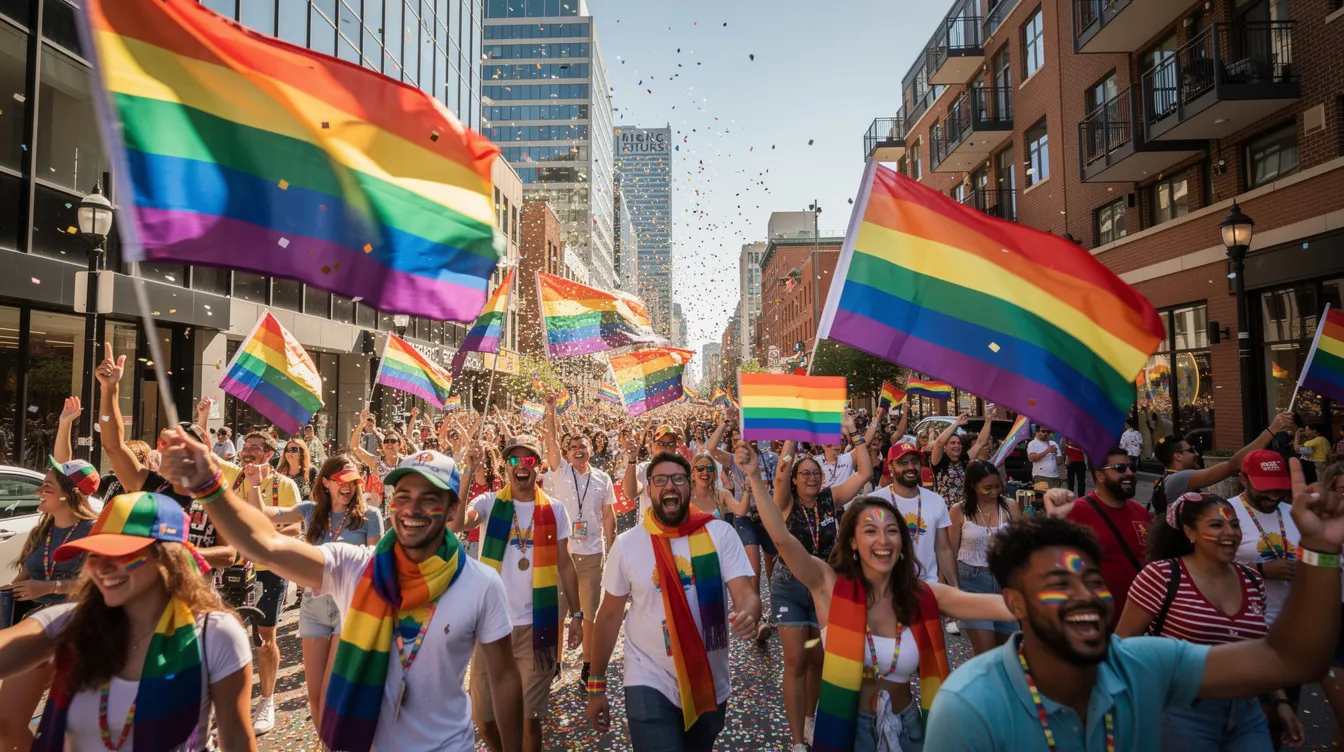
The rainbow flag itself was first flown during the 1978 Gay Freedom Parade in San Francisco, designed by artist Gilbert Baker as a symbol of gay pride and the diversity of the community. It has since become one of the most recognized symbols of LGBTQIA identity worldwide.
Parallel developments unfolded abroad. In England and Wales, the Sexual Offences Act 1967 partially decriminalized homosexual acts between men over the age of 21 in private, a limited but significant reform. Gay rights groups emerged across Western Europe, and the Netherlands began debates about legal equality for same sex couples that would eventually lead to the world’s first same sex marriage law decades later.
The shift in rhetoric during this period was profound. The homophile movement had asked politely for tolerance. The gay liberation movement demanded freedom. Coming out, being visible, living openly, these became not just personal choices but political acts. And the idea that LGBTQ people should change themselves to fit society was replaced by the conviction that society needed to change.
From Pathology to Civil Rights: Legal, Medical, and Political Breakthroughs (1970s-1990s)
The 1970s brought a fundamental shift in how institutions understood homosexuality, a shift that had profound consequences for law, medicine, and politics. If homosexuality was not a disease, then the entire framework of “treatment,” institutionalization, and criminal punishment lost its medical justification.
In 1973, the American Psychiatric Association removed homosexuality from the Diagnostic and Statistical Manual of Mental Disorders (DSM-II), declaring that it was not a mental illness. The decision came after years of activist pressure, internal debate within the psychiatric profession, and growing scientific evidence that sexual orientation was not a pathology. The American Psychiatric Association’s 1973 vote was a watershed: it undermined one of the central pillars of anti-gay discrimination. Gay rights advocates had long argued that you cannot criminalize or penalize someone for a medical condition they do not have, and the APA’s decision gave that argument institutional backing. Later, in 1990, the World Health Organization also removed homosexuality from its International Classification of Diseases, further solidifying the global medical consensus.
Political representation followed visibility. In 1974, Kathy Kozachenko was elected to the Ann Arbor City Council, and Elaine Noble won a seat in the Massachusetts state legislature, both as openly gay politicians. Harvey Milk was elected as San Francisco city supervisor in 1978, becoming one of the most prominent openly gay leaders in the country. Milk used his platform to champion anti-discrimination protections and to encourage LGBTQ people to come out publicly, arguing that visibility was the most powerful tool against prejudice. His assassination later that year, along with Mayor George Moscone, by a former colleague, sent shockwaves through the community and galvanized further organizing. The first openly gay person to hold major elected office in a large American city, Milk’s legacy continues to shape how we think about representation and the courage it demands.
That same decade saw organized backlash. Anita Bryant’s “Save Our Children” campaign in 1977 successfully repealed a gay rights ordinance in Miami-Dade County, arguing that gay and lesbian people posed a danger to children. The campaign was ugly and effective, but it also provoked a massive response. Gay activists and gay rights advocates organized boycotts, fundraisers, and counter-campaigns across the country, building new coalitions and media strategies.
The first National March on Washington for Lesbian and Gay Rights was in 1979, a landmark mobilization that brought an estimated 75,000 people to the nation’s capital to demand federal civil rights protections for lesbian and gay rights. The march demonstrated the growing scale and ambition of the movement. In 1981, the Democratic National Convention endorsed a homosexual rights platform, a significant signal from one of the two major political parties, even though concrete policy action remained slow.
Then the AIDS crisis struck. In 1981, the CDC reported five homosexual men with rare pneumonia, marking the beginning of what would become the AIDS epidemic. The disease devastated gay men and, through government inaction and public stigma, fundamentally reshaped the gay rights movement. The AIDS epidemic in the 1980s significantly impacted the gay rights movement, forcing communities to organize around healthcare, death, grief, and survival in ways that no one had anticipated. ACT UP was formed to respond to the AIDS epidemic in the 1980s, using direct action, civil disobedience, and media-savvy protest to demand faster research, accessible treatment, and an end to discrimination against people with HIV and AIDS. The FDA approved AZT in 1987, the first antiretroviral drug, but access remained uneven and stigma remained brutal.
National legal organizations grew during this period, including the Human Rights Campaign, Lambda Legal, and PFLAG, which litigated employment, housing, and civil rights cases and pushed for legislative change. Legislation is advocated to protect against discrimination in housing and healthcare, though progress remained slow. Local domestic partnership ordinances emerged in cities like Berkeley (1984) and San Francisco (1989), granting some limited rights to gay and lesbian couples in the absence of any path to same sex marriage.
Legal setbacks were real. In Bowers v. Hardwick (1986), the Supreme Court upheld Georgia’s sodomy laws, ruling that the Constitution did not protect homosexual relations between consenting adults in private. The decision was a devastating blow, effectively affirming that states could criminalize private sexual behavior between same sex partners. Anti-discrimination laws remained patchy, and in many places, LGBTQ people could still be fired, evicted, or denied services simply for who they were. Sodomy laws remained on the books in more than a dozen states. But the movement had become too large, too visible, and too organized to be pushed back into silence.
Marriage Equality, Decriminalization, and Military Service (1990s-2015)
From the 1990s onward, three legal arenas, decriminalization of same sex intimacy, the right to marry, and the right to serve in the military, became the primary battlegrounds for LGBTQ rights in the United States and much of the world. Each represented a fundamental question: would the law treat gay and lesbian couples, and indeed all LGBTQ people, as full and equal citizens?
Military service was the first arena to reach national prominence. In 1993, the Clinton administration enacted the “Don’t Ask, Don’t Tell” (DADT) policy, a compromise that allowed gay and lesbian people to serve in the military as long as they concealed their sexual orientation. Homosexual acts, homosexual relations, or any public acknowledgment of being gay could result in discharge. In practice, the policy was punitive: the “Don’t Ask, Don’t Tell” policy led to over 12,000 military discharges by 2011. The policy was finally repealed through legislation signed by President Obama in December 2010, with full implementation in September 2011, allowing service members to serve openly for the first time without fear of expulsion for their sexual orientation.
Marriage and federal recognition moved more slowly and with enormous political friction. The Defense of Marriage Act was signed into law in 1996, defining marriage at the federal level as exclusively between a man and a woman and permitting states to refuse recognition of same sex marriages performed elsewhere. DOMA was an explicit effort to ban same sex marriage at the federal level, and it succeeded in denying federal benefits, including tax, immigration, and social security benefits, to same sex couples for nearly two decades.
But the momentum toward marriage equality was building. Internationally, Denmark had recognized registered partnerships for same sex couples as early as 1989. The Netherlands became the first country to legalize full same sex marriage in 2001. Belgium followed in 2003, Spain in 2005, and Canada passed its Civil Marriage Act in 2005. In the United Kingdom, Section 28, a law that prohibited the “promotion of homosexuality” by local authorities, was repealed in 2003. The Civil Partnership Act was passed in the UK in 2004, granting same sex couples many of the same legal rights as heterosexual marriage. Stonewall UK set up the Diversity Champions programme in 2001, working with employers to create inclusive workplaces.
In the United States, the path to marriage equality was winding. Hawaii’s Baehr v. Lewin decision in 1993 raised the possibility that the state constitution might require recognition of same sex marriages, prompting a national backlash and helping fuel the passage of DOMA. Vermont introduced civil unions for same sex couples in 2000, offering many of the practical benefits of marriage without the name. Then, in 2003, Massachusetts’ Supreme Judicial Court ruled in Goodridge v. Department of Public Health that the state’s ban on same sex marriage was unconstitutional. Massachusetts was the first U.S. state to legalize same sex marriage, and the first legal same-sex marriage in the U.S. occurred on May 17, 2004. Other states followed through a mix of court rulings, legislative action, and ballot measures, though many states also passed constitutional amendments to ban same sex marriage during this same period.
The pivotal Supreme Court decisions came in rapid succession. In Lawrence v. Texas (2003), the Supreme Court struck down anti-sodomy laws nationwide, ruling that laws criminalizing consensual oral and anal sex between adults of the same sex violated the due process clause of the Fourteenth Amendment. The decision explicitly overruled Bowers v. Hardwick, declaring that the state had no legitimate interest in criminalizing private sexual intercourse between consenting adults. The ruling did not mention the equal protection clause directly, but its logic laid the groundwork for everything that followed.
In United States v. Windsor (2013), the Supreme Court struck down Section 3 of the marriage act known as DOMA, ruling that the federal government must recognize same sex marriages validly performed under state law. Edith Windsor, who had been denied a federal estate tax exemption after the death of her wife, became the plaintiff in a case that fundamentally changed the relationship between the federal government and same sex married couples.
And then, on June 26, 2015, the U.S. Supreme Court legalized same sex marriage nationwide in Obergefell v. Hodges, holding that same sex couples have a fundamental right to marry under the Fourteenth Amendment. The Supreme Court ruling was 5-4, and it required all states to both license and recognize same sex marriages. Same-sex marriage was legalized nationwide on June 26, 2015. For millions of gay and lesbian couples across the country, it was the culmination of decades of organizing, litigation, and personal courage. In 2015, the U.S. Supreme Court legalized same sex marriage nationwide.
Alongside marriage, other protections advanced. The Matthew Shepard and James Byrd Jr. Hate Crimes Prevention Act, signed into law in 2009, expanded federal hate crime statutes to include crimes motivated by the victim’s sexual orientation or gender identity. The law was named for Matthew Shepard, a young gay man murdered in Wyoming in 1998, whose death became a national rallying point.
Media visibility played a crucial role during this period. Openly LGBTQ celebrities, athletes, and politicians, including the first openly gay man elected to Congress, the first openly gay politician to win statewide office, and eventually the first openly gay secretary of a federal department (Pete Buttigieg as Secretary of Transportation), helped normalize gay and lesbian relationships and families in mainstream culture. Public opinion shifted dramatically: U.S. support for same sex marriage rose from about 35% in 2001 to over 60% by 2015.

Expanding the Frame: Transgender, Nonbinary, Intersex, and Global Rights (2000s-Present)
While the fight to legalize gay marriage dominated headlines for years, the broader LGBTQIA movement was also deepening its focus on gender identity, gender expression, and the rights of transgender individuals, intersex people, and others whose experiences had long been sidelined even within the movement itself. The acronym itself tells the story of expansion: from “gay rights” to “lesbian and gay” to lesbian gay bisexual to lesbian gay bisexual transgender to LGBTQIA, each addition reflecting a community demanding recognition.
Transgender rights developments have accelerated in the 21st century. Access to gender-affirming care, including hormone therapy and surgical options, has expanded in many jurisdictions. Several countries, including Australia, Canada, and the United States, have introduced non-binary “X” gender markers on passports and identification documents, allowing transgender people and nonbinary individuals to have their identity reflected in legal records. Legal recognition of gender identity in anti-discrimination laws has advanced, though unevenly.
The U.S. military’s treatment of transgender service members has been a flashpoint. In 2016, the Obama administration lifted the longstanding ban on transgender military service, allowing transgender individuals to serve openly. Under the Trump administration, restrictions were reimposed between 2017 and 2019. In 2021, President Biden signed an executive order restoring the right of transgender people to serve openly in the armed forces.
A landmark legal victory came in 2020, when the Supreme Court ruled that the Civil Rights Act protects LGBTQ employees from discrimination. In Bostock v. Clayton County, the Court held that Title VII’s prohibition on sex discrimination in employment encompasses both sexual orientation and gender identity. The decision was a major win for the bisexual transgender and queer community, establishing that firing someone for being gay or transgender is, by definition, sex discrimination under federal law.
Here’s the thing, though: progress in one arena has been met with fierce backlash in others. State-level restrictions on gender-affirming care for transgender youth have proliferated. By mid-2026, 27 U.S. states had passed laws or policies banning or limiting access to gender-affirming healthcare for minors. In 2025, the U.S. Supreme Court upheld Tennessee’s ban on such care for minors in United States v. Skrmetti, a decision that may validate similar laws in other states. Bathroom bills, sports participation bans targeting transgender individuals, and debates over religious exemptions for businesses and service providers have all intensified, creating a patchwork of protections that varies dramatically by state.
Globally, the picture is equally complex. As of mid-2025, nearly 40 countries have legalized same sex marriages, including recent additions like Thailand (2025), which became the first Southeast Asian country to do so, with nearly 2,000 same sex and transgender couples marrying on the first day the law took effect. Taiwan legalized marriage equality in 2019, a landmark in East Asia. The Respect for Marriage Act was signed into law on December 13, 2022, in the United States, requiring interstate recognition of same sex marriages and providing a federal backstop in case the Supreme Court were ever to reconsider Obergefell. But in other parts of the world, same sex relationships remain criminalized, sometimes punishable by imprisonment or even death. The gap between the most progressive and most repressive countries has, in some ways, widened.
Intersex and asexual communities have pushed for greater recognition under the LGBTQIA umbrella. Intersex activists have campaigned globally to end non-consensual “normalizing” surgeries on intersex infants, arguing for bodily autonomy and informed consent. Asexual communities have organized to gain recognition of asexuality as a valid orientation, not a disorder or deficiency. Both movements remain at earlier stages of legal advocacy compared to the gay and lesbian rights struggles that preceded them, but their visibility is growing.
Intersectional movements have highlighted the compounded discrimination faced by LGBTQIA people who are also people of color, immigrants, disabled, or economically marginalized. The 2016 Pulse nightclub attack in Orlando, which killed 49 people at a predominantly Latinx LGBTQ event, underscored the intersection of anti-LGBTQ violence, gun violence, and racial targeting. In 2020, the Brooklyn Liberation march drew tens of thousands to center the lives and safety of Black transgender people, reflecting a growing awareness that the most marginalized members of the community often face the greatest danger.
The Queer the Census campaign was launched to ensure LGBTQ individuals were counted in 2010, reflecting a broader push for data, visibility, and inclusion in public life. Pete Buttigieg became the first openly gay secretary of a federal department when he was confirmed as Secretary of Transportation in 2021, and other openly gay leaders have taken office at every level of government, from city councils to the U.S. Senate. The first openly gay person elected to a state legislature, the first openly gay man to run a serious presidential campaign, each milestone expanding what the public imagines as possible.
Continuing Struggles and the Future of LGBTQIA Rights
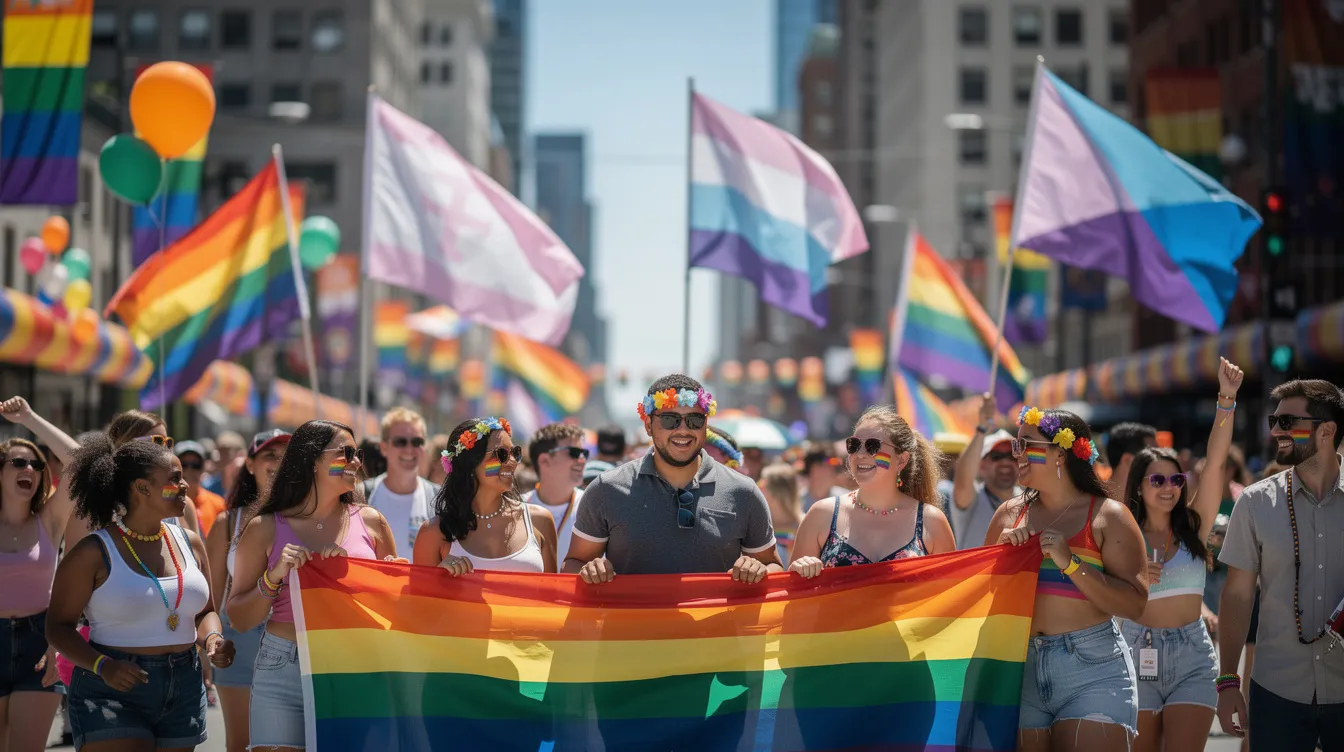
It is worth pausing to take in how much has changed. Within living memory, homosexual activity was a felony in most of the United States. Gay men and lesbians could be fired from federal government jobs solely for their sexual orientation. The American Psychiatric Association treated homosexuality as a mental disorder. Same sex relationships had no legal recognition of any kind. Transgender people were almost entirely invisible in public life. Today, same sex marriage is the law of the land in the United States and in nearly 40 countries worldwide. Gay pride parades draw millions of participants across every continent. Openly gay politicians serve at the highest levels of government. Nondiscrimination protections, while incomplete, exist in more places than ever before.
And yet. 1 in 3 LGBTQ+ Americans reported facing discrimination in 2026, according to recent survey data. Violence against transgender people, especially Black trans women, remains alarmingly high, and many hate crimes go unreported. Legal protections remain uneven: many states still lack comprehensive nondiscrimination laws covering gender identity in employment, housing, and public accommodations. Court challenges and legislative efforts continue to chip away at rights that were only recently won. The question of whether the Supreme Court rules in the future to narrow or overturn existing protections is not hypothetical but an active concern.
Religious exemption debates remain one of the most contested areas. Cases like Masterpiece Cakeshop and Fulton v. City of Philadelphia have tested where the line falls between religious freedom and LGBTQIA equality, and the courts are still defining that balance. For many LGBTQIA people, these cases are not abstract legal questions but lived experiences of being turned away, denied service, or told that their family is less worthy of recognition than a heterosexual marriage.
The populations most often left behind deserve direct attention. LGBTQIA people who are Black, Indigenous, and people of color face compounded discrimination that mainstream rights organizations have not always addressed. LGBTQ migrants and asylum seekers flee persecution only to face hostile immigration systems. Disabled and low-income community members struggle to access healthcare and legal services. LGBTQIA youth experiencing family rejection are disproportionately represented among homeless young people. The movement’s future depends on centering these experiences, not treating them as footnotes.
Education matters. States like California, New Jersey, and Illinois have mandated the inclusion of LGBTQ history in school curricula, a recognition that visibility in classrooms changes future attitudes and reduces bullying and isolation. In other states, legislation restricts what teachers can say about sexual orientation or gender identity, creating a fractured landscape where a student’s access to accurate information depends on their zip code.
The history of LGBTQIA rights is not a straight line from persecution to freedom. It is a story of people who refused to accept that their love, their identity, or their existence was something to hide. It is a story of legal briefs and street protests, of quiet acts of coming out and loud demands for recognition, of devastating losses and hard-won victories. Same sex marriage, the repeal of sodomy laws, protections for gender identity in employment, the visibility of openly gay leaders and transgender people in public life, these are real and meaningful achievements. They are also not permanent unless they are defended. The glass, as it were, is refillable. Rights advances require continual advocacy, coalition-building, and the willingness to keep showing up, especially for the members of the community who are still waiting for the protections that others now take for granted.
About the Author: Gareth Redfern-Shaw
