
Erotic performance poetry lives in the space between breath and longing, between a whispered confession and the hush of an audience leaning closer. It is spoken word poetry designed not for the page but for the body: yours, and the bodies listening. Unlike generic slam poetry or standard open mic fare, this art form centers desire, intimacy, and sexuality with deliberate attention to consent, vulnerability, and sensory craft. It’s poetry you feel in your chest before you understand it with your mind.
Spoken word has gained popularity through social media in recent years, and erotic spoken word carved its own path through underground open mic nights, sex-positive festivals, and YouTube channels dedicated to queer, kink-aware, and body-celebrating performance. Between roughly 2013 and 2023, cities like New York, London, and Berlin saw a quiet surge of themed slam nights, cabarets, and late-night poetry events where desire was not just permitted but centered. Spoken word has grown significantly in the last 15 years, and erotic performance poetry rode that wave into increasing visibility.
This article is a practical guide to creating your own erotic performance poetry. By the end, you’ll have a draft, a performance plan, and ideas on where to share your piece. Whether you’re a writer who has never spoken a line aloud or a seasoned poet curious about bringing desire into your work, this is your map.
Understanding Erotic Performance Poetry
Erotic performance poetry is poetry written to be spoken aloud, centering desire, bodies, and sexuality, often performed in slam poetry spaces, cabaret stages, and sex-positive gatherings. Spoken word is designed for performance, not reading. Poetry can be read from the page or performed, but erotic performance poetry specifically demands embodiment: the warmth in your voice, the way your breathing shifts, the relationship you build with the audience in real time.
That distinction matters. Page erotica is written to be read silently, privately. It relies on a reader’s imagination and interior world. Performance erotica, by contrast, is designed for audience reaction. It lives or dies in the room. General spoken word poetry may or may not be sexual. Spoken word often addresses contemporary social issues, and slam poetry topics can include personal experiences and social issues ranging from identity to injustice. Common themes in slam poetry are growing up and lessons learned. Slam poetry often explores feelings of injustice and prejudice. Spoken word can explore various topics like personal experiences and social issues. But erotic performance poetry takes the same tools and directs them toward the landscape of desire.
What separates strong erotic performance poetry from shock-value provocation is intention. The best work balances explicitness with metaphor, grounding itself in consent, agency, and mutual pleasure rather than spectacle. Erotic poetry focuses on chemistry and atmosphere over explicit details. Picture, for example, a 2022 queer slam night in London: low lighting, a small brick-walled room, the audience close enough to hear each other breathe. A poet steps to the mic, voice beginning soft, building sensory images of wet pavement and warmth, then turning to tactile detail. Explicit acts are implied rather than catalogued. The room exhales together. That’s the tone.

Setting Boundaries, Safety, and Consent
Before you write a single word about desire, you need to know where your own boundaries are. This isn’t a formality. Emotional and physical safety are the foundation that makes creative freedom possible. Without them, the work can become a source of harm to yourself or others.
Here’s the thing: creating your own erotic performance poetry means getting honest with yourself about what you’re willing to share. Sit with questions like these. What sexual or erotic details am I comfortable describing, including specific acts, body parts, fantasies? What parts of my history are off-limits, even in metaphor? Who is my intended audience? There’s a real difference between performing for an anonymous online audience and speaking directly to a room of people at a local bar in 2026. Could this content be linked to my legal name, and am I okay with that? Would I be comfortable if a person from my family, my school, or my workplace found this work?
You don’t need perfect answers. But you need to have asked.
When depicting kink, power play, or fantasy, it is your responsibility to frame those scenarios with signals of mutuality and negotiation. Erotic spoken word must never glamorize non-consensual situations. You can write about power dynamics, about surrender, about intensity, but the poem should carry some signal, either explicit or embedded in its framing, that what’s happening is wanted. A line like “My breath mingles with yours, consent like heat between lips” communicates agency. A line like “You didn’t say no, so I took what I wanted” removes it. That’s a line that crosses from erotic into something harmful.
One thing most poets don’t talk about enough is aftercare for performers. After an intense spoken word performance, especially one centered on desire, vulnerability, or difficult erotic memory, your nervous system may need tending. Grounding exercises help: deep breathing, stretching, placing your feet flat on the floor. Journaling right after a show, even just a few sentences about what felt heavy or what surprised you, can process the experience. Debriefing with a trusted friend is not indulgent; it’s practical. Think of it the same way you’d think about aftercare in any intimate context. The stage is intimate, too.
Finding Your Erotic Voice and Story
Desire is a story. It has tension, conflict, longing, sometimes resolution, sometimes not. When you begin writing erotic spoken word, you’re not cataloguing sexual acts. You’re telling stories about wanting, being wanted, the space between reaching and touching.
Daily observation can inspire writing. So can memory, fantasy, and the strange electricity of overheard language. Here are a few prompts to help you find material:
Keep a dedicated “desire notebook” for images, sensations, scraps of dialogue, bodily memories. Heat, sweat, perfume, the sound of breathing, the texture of fabric. These raw materials become the vocabulary of your own piece. Ground descriptions in all five senses to enhance erotic writing. Not just what you saw, but what you tasted, heard, smelled, felt against your skin.
Here’s what that might sound like in practice: “In your neck, a pulse like summer rain warm against my skin. I taste salt from memory.” Non-pornographic. Focused on atmosphere, metaphor, implied touch. That’s the register you’re developing.

Writing the Erotic Spoken Word Piece
The goal here is to write spoken word poetry, not short stories or prose. You’re crafting something that sounds alive when read aloud, something where the mouth matters as much as the mind. When you write poetry for performance, every phrase needs to earn its place in the air.
Beginning: Anticipation. Your opening sets the mood. Writers can start with a “gateway line” to develop their theme, a single image or phrase that frames the entire erotic situation. A gateway line captures the theme of a spoken word piece. Think of it as your hook: “Tonight I let my skin remember your name.” That line tells the audience what world they’re entering. It doesn’t explain. It invites.
Middle: Build of Tension. This is where sensory details enhance the audience’s connection to the poem’s message. Emphasize sensory details to create immersive scenes. Layer touch, sound, temperature, taste. Incorporate dialogue for a richer story, even a single quoted line (“Stay” or “Tell me what you want”) adds dimension. Spoken word follows a story structure: exposition, climax, resolution. Your middle section is the climb.
End: Release or Longing. The ending can be physical release, emotional confession, or unresolved desire that lingers. Sometimes ambiguity is more powerful than closure. A poem that ends on a question, a withheld word, a breath, can haunt the listener longer than one that resolves neatly.
Spoken word poetry uses literary devices like alliteration and imagery. Employ poetic devices like repetition for impact: repeating a phrase (“again,” “hold me,” “the way you”) builds rhythm and echoes desire. Use metaphor, comparing touch to weather or voice to music. Use strategic line breaks for breath and pacing. Experimenting with form creates rhythm in poetry.
The most important habit in this creative writing process: speak each line while drafting. Whisper it. Say it loud. If a phrase feels clumsy in your mouth, cut it or reshape it. Your first draft is never your final draft. Write with the mouth in mind.
Balancing Explicitness, Subtext, and Poetic Craft
Erotic performance poetry ranges from the barely suggestive to the unapologetically explicit. The key is intentionality, not censorship. You get to choose your register. But that choice should be deliberate, not accidental.
Here are three distinct tones, each with its own craft:
Playful flirtation and innuendo. This tone relies on double meanings, implication, the thrill of the unsaid. “Your laughter slides across the room, daring me.” “You taste like moonlight and laughter, soft hands brushing over skin.” The audience fills in the gaps. Half the trick is trusting them to do so.
Intimate tenderness. Slow pace, sensory focus, emotional presence. “Your pulse, dawn’s soft hum, carries warmth under my ribs.” “In your arms I learn the weight of full breath.” This register isn’t about acts. It’s about closeness.
Raw explicitness. Carefully chosen explicit language, minimal slang, always in service of texture or emotion. “My lips part on your skin, admit everything.” “Fingers tracing where you ache.” This tone works when trust has been built with the audience, when the poem has earned its directness.
Use vivid imagery to avoid clichés. Subtext and implication can be more powerful than graphic description. Consider ending a line just before the obvious word: “I pull yours toward… but the space between your thighs is a horizon I dare not cross.” The listener’s imagination does the rest. That’s a subtle way to create intensity without spelling everything out.
A note on language politics: avoid stereotypical or dehumanizing descriptions of bodies. Don’t reduce a person to a fetish object based on race, gender, or ability. Don’t use ableist metaphors (“crippled by want”) as stand-ins for desire. Erotic language should celebrate, not flatten. The freedom to write about desire comes with the responsibility to do it with awareness.
Shaping for Performance: Rhythm, Breath, and Voice
What works on the page doesn’t always land in the room. Text that reads beautifully in silence can feel too dense, too fast, or emotionally flat when spoken. Spoken word uses intonation and rhythm to convey meaning in ways that the written word alone cannot.
Start by marking up your printed poem for performance. Underline words you want to stress. Use slashes for pauses: a single slash (/) for a beat, a double (//) for a longer silence. Write notes in the margins: “whisper here,” “slow down,” “let this line hang.” This markup becomes your performance score.
Suggestive pacing is powerful in erotic writing. Intimate lines benefit from a slower tempo, letting each word settle into the listener’s body. Nervous or excited moments might rush, words tumbling together. Pacing and pauses in performance build tension. Dramatic pauses can enhance audience engagement during performances, especially after an intense image. Let the silence breathe. A beat of quiet after “I wanted to say your name but my mouth was full of yes” gives the audience time to feel it.
A personal poet voice should be clear and rhythmic. Sensual but grounded: articulate without being stiff, relaxed jaw, low steady breath. Avoid over-the-top theatrics, no performative moaning, no melodrama. Your voice should serve the atmosphere, not perform on top of it. Adjusting volume can change the tone and mood of a piece. Drop to a near-whisper for intimacy. Lift for confession or declaration. Unique delivery in performance enhances engagement.
Practical notes: hydrate before you perform. Rest your voice if you’ve been talking all day. Posture matters: spine open, chest soft, weight balanced. For eye focus, most poets look just over heads for sweeping imagery, then drop to direct eye contact on lines with emotional stakes.
Body, Gesture, and Stage Presence
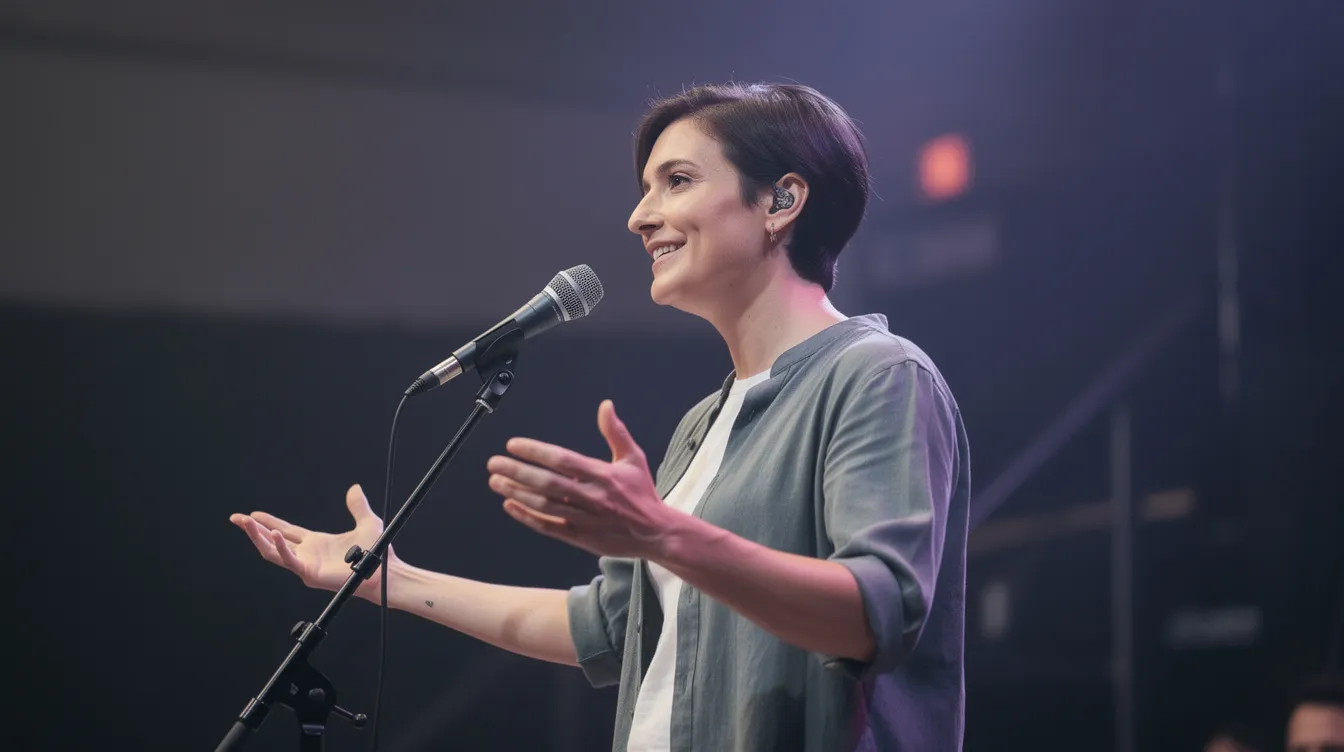
Erotic performance is not about stripping on stage. It’s about how you inhabit your whole body while speaking. The way you stand, shift your weight, use your hands, all of it communicates desire, vulnerability, or power before you say a word.
Movement should be minimal and intentional. A step forward on a confession. A hand to the heart on a vulnerable line. A turned back on a moment of withheld pleasure, then slowly turning to face the audience again. A breath-pause while standing still, letting the audience see your silhouette. Small shifts in weight can signal internal conflict. You don’t need choreography. You need presence.
Choose clothing that makes you feel something, powerful, soft, embodied, and that allows you to move and breathe. Fabric that brushes your skin, a color that evokes mood. But also ensure safety: comfortable footwear, nothing that restricts your movement or risks a wardrobe distraction. You want to be thinking about your poem, not your hemline.
Engage the audience through eye contact and body language. Eye contact with the audience enhances performance impact. Hold a pause with stillness. A small smile after a loaded line. Deliberate eye contact with one audience member on a confessional moment. These micro-movements build tension without being cheesy. Facial expression tells what words sometimes cannot. Let vulnerable lines show in your mouth, your eyes. Subtlety hits harder than exaggeration.
Rehearsal: From Private Practice to Confident Delivery
Start alone in a room. Read your poem aloud to your reflection, or just to the walls. Then record yourself on your phone, audio first, video later. Then perform for a trusted friend or partner. Then a small group. Each stage reveals different things: breath issues, pacing problems, the particular feeling of being exposed.
If stage fright or embarrassment stops you, try performing in low light first. Whisper lines to feel the sound without feeling watched. Rehearse with a friend online with cameras off. These aren’t shortcuts. They’re scaffolding.
Specific drills help. Read the same poem at different speeds: painfully slow, comfortable, rapid. Emphasize different words to see how meaning shifts. Try standing versus sitting. Experiment with quieter and louder deliveries. Map sections of the poem to movement or gesture, then rehearse while pacing or walking so the lines feel tied to your body.
For memorization, performers should memorize their spoken word pieces for better connection. Memorizing your poem improves audience connection during delivery. But don’t memorize line by line. Break the poem into sections, using mental “story beats”: anticipation, build, tension, release. These anchors are easier to remember than individual words. Practice while walking so lines attach to physical rhythm. That said, memorization isn’t always required. Authentic performance comes from vulnerability, not perfection.
Here’s what I want you to hear: awkwardness is part of rehearsal. It’s not a sign you’re failing. It’s information. What feels strange in private often lands powerfully in public. Rehearsal is where awkwardness transforms into intentionality.
Performing in Public: Venues, Events, and Etiquette
Erotic spoken word thrives in specific spaces: sex-positive open mics, themed slam poetry nights, adult cabarets, late-night festival slots, and some queer performance evenings. Not every venue welcomes erotic content, and that’s fine. Your job is to find the right room.
Research event rules before you show up. Many spaces have age restrictions (18+ in most countries, sometimes 21+ depending on venue and jurisdiction). Content policies vary: some allow explicit language, others draw lines around nudity or non-consensual themes. Time limits are typical. In poetry slams and slam competition formats, you usually get three to four minutes per slam poem. Always check mic availability, sound setup, and lighting. Contact organizers if you’re unsure whether your material fits.
Performance etiquette matters. Arrive early. Test the sound. Respect the stage manager and the time limits. Do not touch any audience member without consent. Do not single out people in sexual ways without prior agreement. Respect other performers: no heckling, no stealing focus. These aren’t restrictions on your art. They’re the infrastructure that makes the art possible.
For online performance, platforms that host a youtube channel or streaming content may allow adult language but have policies around explicit sexual content. Be aware of digital permanence. Using a pseudonym is a valid choice. Consider privacy settings, age gating, and audience restrictions. Pre-recorded videos allow editing; livestreams are less forgiving.
Imagine a first-time erotic poet in 2025, performing at an open mic in London. They’ve chosen a poem built on innuendo rather than raw explicitness. They arrive early, check the mic with the stage tech. During performance, they notice the audience leaning forward. Afterward, a few people approach with compliments, some shy. But the poet also realizes a few lines were rushed, that their gestures felt strong but their pacing needs work. They jot notes. They’ll come back.

Revision After the Stage: Learning From Each Performance
Performance is feedback. Audience silence, laughter, sighs, applause: all of it tells you which lines land and which drag. The moment you step off stage, you have information that no amount of private rehearsal could give you.
Great poetry often requires multiple drafts for refinement. Build concrete revision habits. Right after the show, jot quick notes: lines you stumbled on, moments where emotion faded, physical sensations during performance (heart racing, throat tight, hands shaking). Then rest. Re read the poem the next day, not immediately. Distance reveals what intensity obscures.
Solicit feedback from trusted peers or mentors who understand erotic content and performing poetry, not random strangers. Ask specific questions: Did I maintain agency throughout? Did the erotic tone feel coherent or uneven? Was the language respectful? Did my gestures help or distract? Did the audience feel included?
One thing worth saying clearly: learn to separate criticism of craft from shaming of content. Feedback on pacing, clarity, voice, and delivery is invaluable. But if someone critiques your erotic themes themselves, that’s not necessarily a craft note. It may be their discomfort. Protect your creative confidence while staying open to genuine craft improvement.
Experimenting With Music, Sound, and Multimedia
Some erotic performance poets integrate music, soundscapes, or visuals to deepen atmosphere. Spoken word can be paired with music for performances, and poets are increasingly using music to enhance spoken word performances. Spoken word performances can include various artistic elements like music. This isn’t new. The intersection of spoken word and hip hop, jazz, and electronic music has a long history.
Simple additions can be powerful: a single looped guitar riff behind a poem about longing, a low synth pad under a piece about touch, recorded city ambience behind a poem about a one-night encounter. The key is restraint. Music should support the words, not drown them. The poem remains the core. If your voice can’t be heard clearly, the music is too loud.
For advanced performers who already feel solid in basic delivery, more experimental options exist: projection of abstract visuals (colors, textures, shapes) behind you, soft lighting changes that shift intensity, or subtle costume elements like removing a shawl mid-poem to signal shedding inhibition. But these are optional. They’re expansions, not requirements. Master your voice and words first.
Sharing, Community, and Ongoing Practice
Community is not optional for this work. Online groups, local workshops, and sex-positive writing circles create the conditions for growth. You won’t hear what your poems can become until you share them with people who understand this particular intersection of language and desire. But be intentional: don’t share with the same people every time. Seek out new listeners, new perspectives.
Giving and receiving feedback in erotic spoken word requires care. Focus on craft: imagery, pacing, performance techniques, tonal choices. Avoid judging someone’s fantasies. Ask questions like: Did this line make me feel something? Did the gestures feel congruent with the words? Was the pacing engaging? Reading established poets can enhance understanding of intimacy in poetry, so make time to listen to recordings, watch video archives, and study how other slam poets and spoken word artists handle desire.
Set long-term goals. Draft one erotic spoken word poem per month. Perform at an open mic each season. Keep notebooks, revise drafts, create space for this practice in your life the same way you’d make space for any other discipline.
Here’s how you start: tonight, draft a single sensual image. One line, one idea, one moment of wanting. Speak it aloud in an empty room. Notice what your body does, how your voice changes, what you feel in your chest. That’s the beginning. That’s all it takes to begin writing. Your voice, your desire, your words. They belong on a stage whenever you’re ready.
FAQ: Common Questions About Erotic Performance Poetry
This section tackles specific questions beginners ask when they’re considering creating their own erotic performance poetry.
Can I perform erotic poetry at a regular open mic?
Yes, but research the policy first. Some open mic nights explicitly restrict sexual content. Others welcome mild erotic material. If you’re unsure, contact the organizer ahead of time and ask about content rules. Use content warnings if the space calls for them. Not every room is the right room, and that’s not a rejection of your work. It’s about fit.
How explicit is “too explicit”?
This varies by venue, audience, and legal jurisdiction. What feels too explicit on the page may land differently in a spoken word performance, where tone, pacing, and context shape how words are received. The point isn’t to self-censor but to make deliberate choices. If explicit language serves the emotion and texture of the poem, and the audience has been prepared, it can be an interesting piece of craft rather than a shock tactic. Most poets find their calibration through trial and experience.
Should I use my real name when posting erotic spoken word online?
Using a pseudonym is entirely valid. Consider digital permanence, the potential impact on family or employment, and your own comfort. Some performers choose to separate their stage identity from their personal life. It’s not dishonest. It’s a boundary. And boundaries are what this whole art is built on.
What if my family or coworkers find my performances?
Anticipate this possibility by controlling distribution: private accounts, age-restricted content, pseudonyms. Decide ahead of time how much you’re willing to share of your identity. For a lot of people, this feels like a big deal, and it is. But it’s also a decision you get to make on your own terms, not something that should be made for you by fear.
Are there age restrictions or legal considerations I should know about?
Most erotic performance poetry spaces require performers and audience members to be adults, typically 18+ in many countries, sometimes 21+ depending on the venue. Legal restrictions may apply to explicit content or nudity. Intellectual property rights matter for recorded performances, too. Always check local laws and venue requirements. This isn’t the kind of thing where you guess and hope for the best.
About the Author: Gareth Redfern-Shaw

Share This Story, Choose Your Platform!
Related Articles

14.6 Min Read
185 Views
3 Today

11.2 Min Read
167 Views
4 Today

13.3 Min Read
189 Views
4 Today